Waves and optics
Exploring oscillatory phenomena, from pendulums to wave optics.

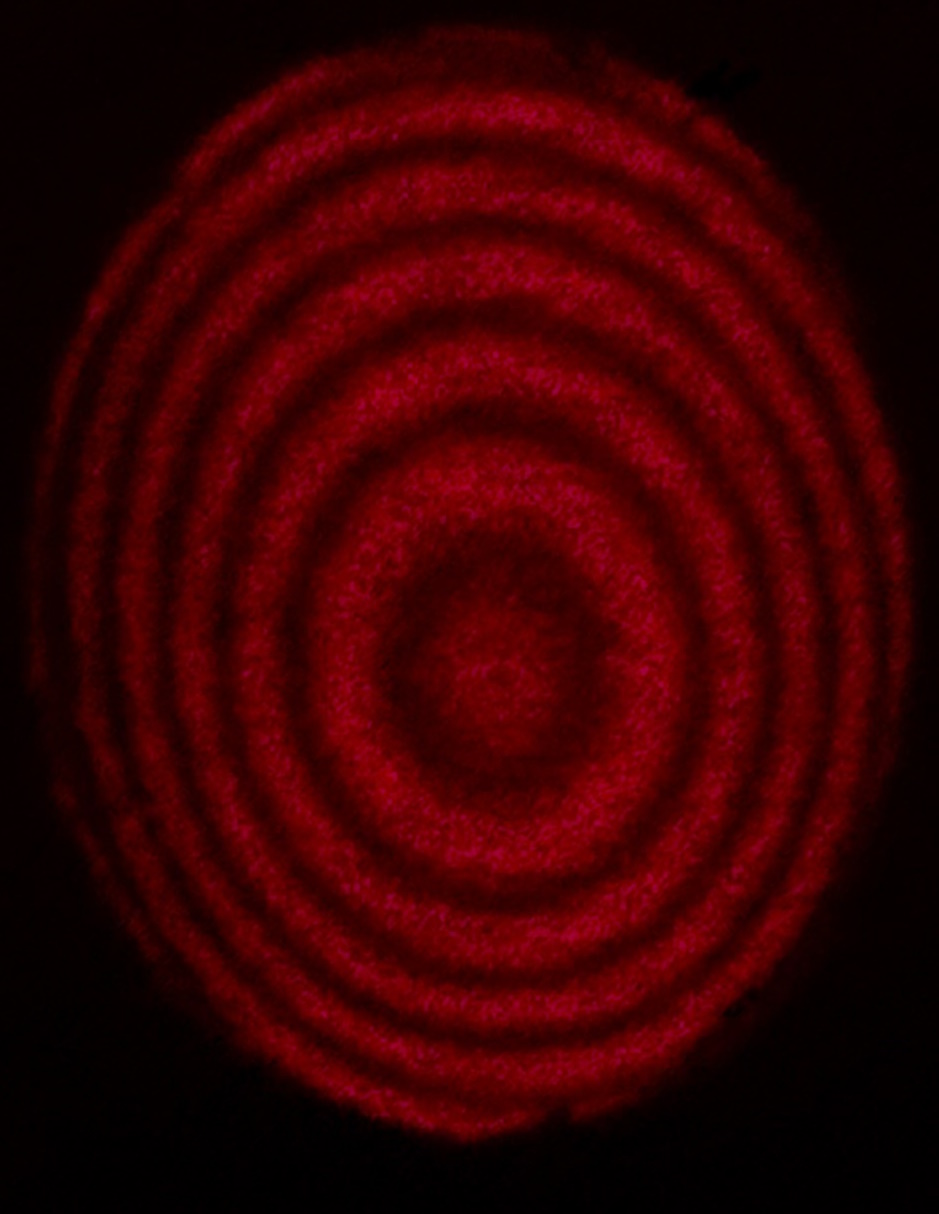
Riding the wave: determining laser wavelength using a Michelson interferometer
Author: Brookelyn Velmont
Abstract: The wavelength of a helium-neon gas laser was determined using a Michelson interferometer by relating mirror displacement to interference fringe shifts. As the movable mirror was displaced, the number of fringe shifts m was counted and the corresponding mirror displacement d was recorded. Plotting d as a function of m revealed a linear relationship, where the slope corresponds to half the wavelength of the light. Using this result, the wavelength was determined to be 653(6)nm.
Getting swingy with it: determining gravity using a simple pendulum
Author: Brookelyn Velmont
Abstract: This experiment uses a simple pendulum to measure the acceleration due to gravity. This is done by timing the pendulum’s oscillations for several different string lengths. For small release angles, the motion of the pendulum can be approximated as simple harmonic motion, leading to the linear relationship between the period of oscillation and the square root of the length of the pendulum. The time for ten oscillations was measured for multiple trials for ten different lengths. A weighted linear fit of period versus the square root of length was used, whose slope was proportional to \(g\). This gave \(g\) = 10.01 \(\pm\) 0.04m/s\(^2\). This value is slightly larger than the accepted value, likely due to systematic timing uncertainties. The results clearly follow the expected linear relationship.
It takes two: finding the normal modes in a coupled pendulum system
Author: Brookelyn Velmont
Abstract: The normal modes of a system of two coupled pendulums were determined by using angular displacement data recorded with rotary motion sensors. As the pendulums oscillated, the angular displacements were measured simultaneously and used to construct a covariance matrix describing their correlated motion. Diagonalization of this covariance matrix revealed two independent mode coordinates corresponding to in-phase and out-of-phase oscillations. Projection of the experimental data onto these mode coordinates produced a clear separation of the system’s behaviors, with the in-phase mode dominating the motion.

Dispersing doubt: how wavelength affects refraction
Author: Skylar Farr
Abstract: A comparison of the index of refraction of two lasers as refracted through the same media will result in the dispersion. By using the Michelson Interferometer experiment to find the wavelengths of various lasers and a semi-cylindrical prism to calculate the indices, the different of the two indices can be taken to get the dispersion of the two different wavelengths from the lasers. The calculated dispersion was 0.014 \(\pm\) 0.13. This dispersion is consistent with what would be expected from only two separate lasers that were not many wavelengths apart. Given more options for laser colors to analyze, the data would be a lot more accurate.
Reflecting on microwaves with Lloyd’s mirror.
Author: Skylar Farr
Abstract: The wavelength of a microwave transmitter was determined by using a method of interferometry called Lloyd's Mirror. This method consists of a transmitter, reflector, and a receiver. By relating the total path a wave travels, to the distance of a reflector away from the wave, the wavelength of said microwave can be calculated using a linear regression. Two sets of data taken are consistent in showing distance does not change wavelength despite the imprecision of the results when compared to the recorded wavelength of the microwave transmitter. Outside influences creating additional reflection are likely the cause of this imprecision.