Quantum
Exploring quantum phenomena, with contributions on the photoelectric effect and electron diffraction.

Estimating Planck’s constant using the photoelectric effect
Author: SemaJe Zechariah Farmer
Abstract: The photoelectric effect occurs when light of a sufficiently high frequency strikes a surface, exciting the electrons on that surface to the point that they are ejected from it. Those ejected electrons are called photoelectrons, which can be collected and sent through a circuit. By measuring the resulting current and the negative voltage required to stop it at various frequencies and intensities, some essential relationships can be established. The first is the relationship between stopping voltage and frequency. This relationship is linear, and using its slope, Planck’s constant was estimated to be 6.5(2) \(\times\) 10\(^{-34}\) Js. The second relationship is between the stopping voltage and intensity. Classical wave theory predicts that an increase in intensity should increase the stopping voltage. In reality, the data shows that the two are entirely unrelated. This result directly contradicts wave theory, supporting theories of light’s particle-like behavior and the existence of photons.
Determining the interplanar spacing of graphite using electron diffraction
Author: SemaJe Zechariah Farmer
Abstract: When firing a beam of electrons at a crystal lattice, those electrons will diffract. The pattern that forms as a result of that diffraction will depend on and be unique to the crystal structure of the targeted lattice. By combining de Broglie's theory with Bragg's law, a relationship can be derived between the diffraction angle of electrons and their accelerating voltage. This relationship can then be used to determine fundamental structural information about the crystal. Using this method, the inter-planar Spacing for \(d_{100}\) and \(d_{110}\) of graphite were determined to be \(1.7 \pm 0.1 \) A and \(1.4\pm 0.2 \) A, respectively.
Waves and optics
Exploring oscillatory phenomena, from pendulums to wave optics.
Dispersing doubt: how wavelength affects refraction
Author: Skylar Farr
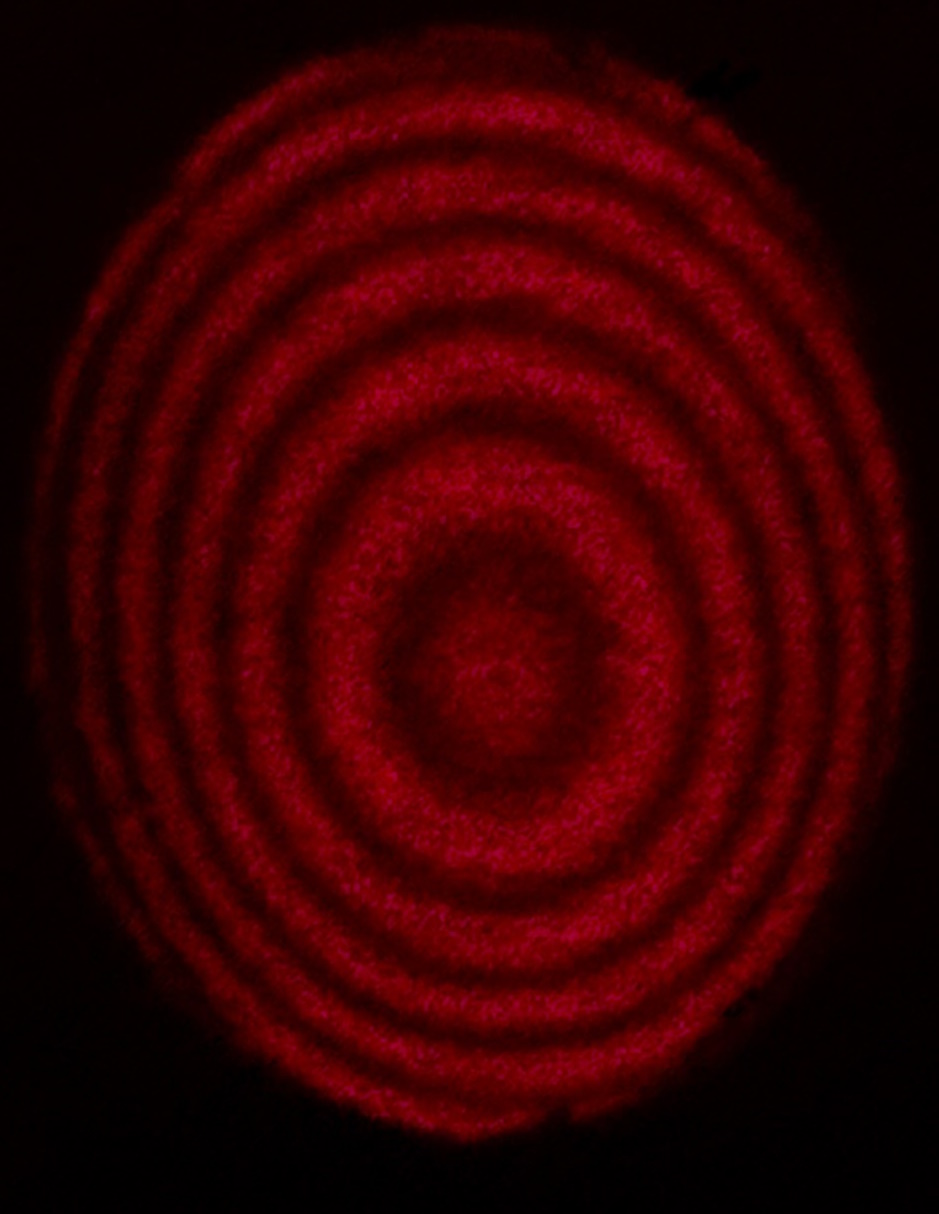
Abstract: A comparison of the index of refraction of two lasers as refracted through the same media will result in the dispersion. By using the Michelson Interferometer experiment to find the wavelengths of various lasers and a semi-cylindrical prism to calculate the indices, the different of the two indices can be taken to get the dispersion of the two different wavelengths from the lasers. The calculated dispersion was 0.014 \(\pm\) 0.13. This dispersion is consistent with what would be expected from only two separate lasers that were not many wavelengths apart. Given more options for laser colors to analyze, the data would be a lot more accurate.