Waves and Optics
Featuring a variety of experiments regarding microwave interferometry, waveguides, and standing sound waves.

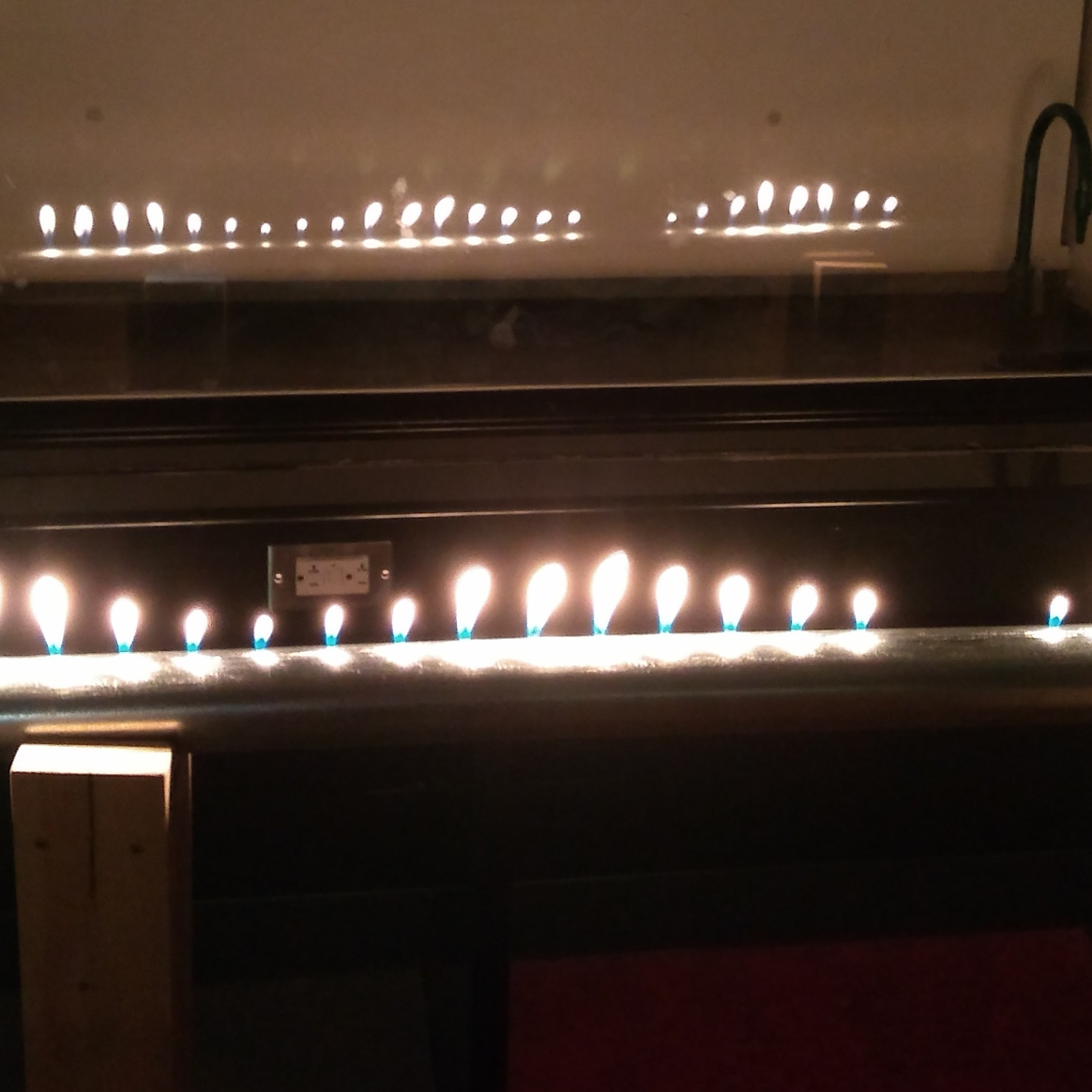
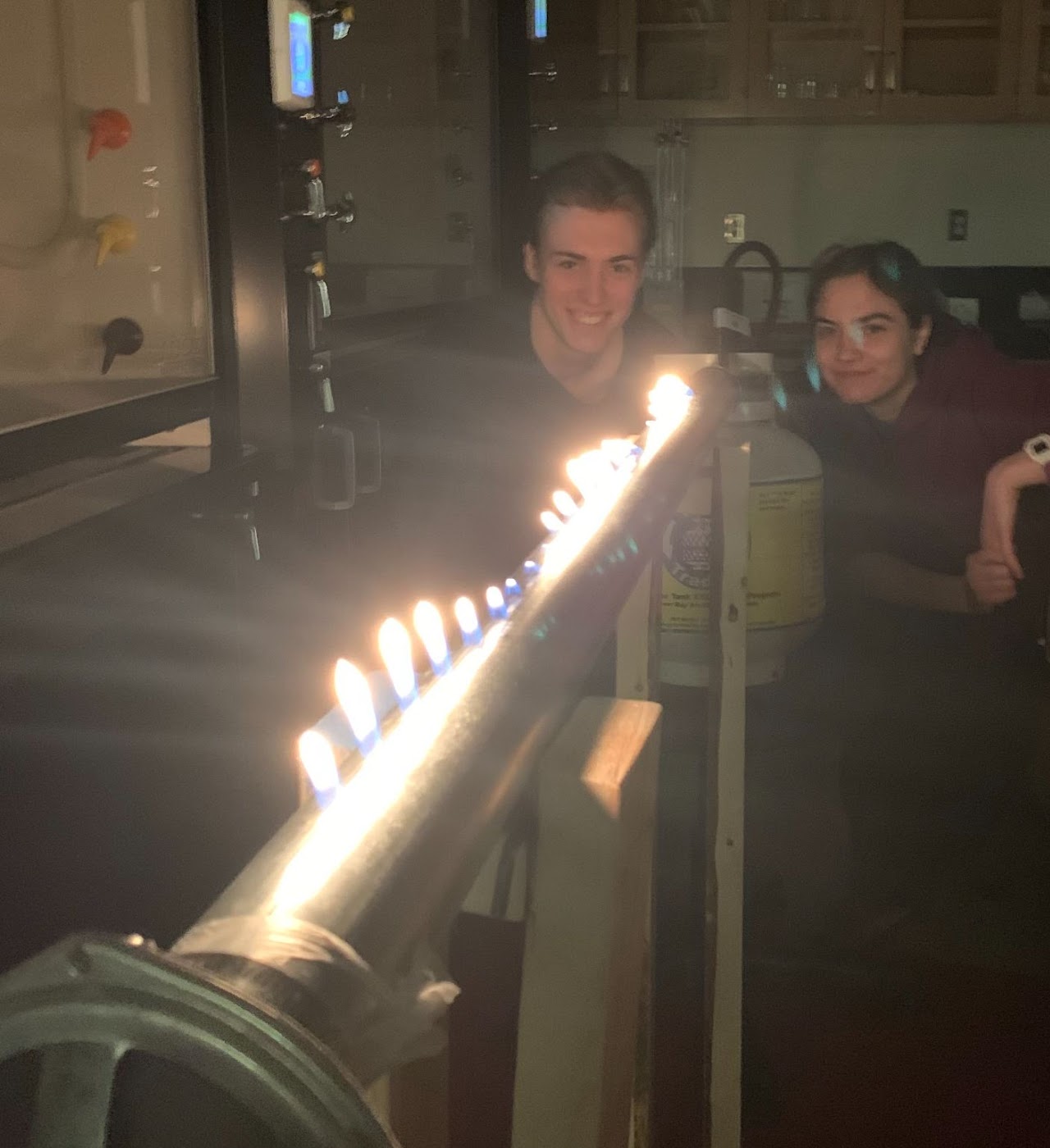
Measuring the speed of sound in propane gas using a Rubens tube
Author: Andrew Valentini
Abstract: In this report, the speed of sound in a Rubens tube is determined by varying the frequency of a tone applied to the exterior of one of the tube's ends and measuring the wavelength of the standing waves produced by the release of the flammable gas through a line of holes at the top of the tube. We use the Phyphox application to determine the tone frequency causing standing waves across the tube and make approximate measurements of the wavelength at these frequencies with a meter stick. The wave relationship tells us that only the wavelength and frequency of a wave are required to determine its speed so, with this data, we are able to determine the speed of sound in the propane gas inside the tube. Through our method, we find this wave speed to be around 210 +/- 5 m/s, which is 18% smaller than the currently accepted value.
Measuring the speed of light with a Michelson interferometer
Author: Andrew Valentini
Abstract: In this report, the speed of light in air is inferred with the use of a Michelson interferometer built from Pasco's basic microwave optics system. We vary the length of one of the interferometer's arms and count the number of corresponding fringe shifts of the light in a transceiver. A voltmeter is used in the microwave transceiver to measure the variation in the light's intensity while the length of the arm is varied. After inferring the wavelength of the transmitted light, we determine the speed of light to be (3.01 +/- .021) 10^8 m/s, which is 10% greater than the speed in a vacuum.

Characterizing a Lloyd’s mirror interferometer
Author: Kaitlyn Prokup
Abstract: Lloyd's mirror interferometers are optical devices used in and relevant to many fields of research today, such as underwater acoustics, sonar research, and laser research. Our work sought to construct a Lloyd's mirror to justify the device's mechanisms and characterize it. We assembled our Lloyd's mirror by placing a transmitter at a distance d = 1.0287 m across from a receiver, with a metallic reflector placed perpendicular at a distance h to induce interference. To characterize our device, we derived a value for the wavelength of the signal emitted by the transmitter by varying h across a set of values 0.117 m to 0.320 m, where we subsequently measured the intensity I of the signal to be between 0.72 mA and 9.40 mA. This allowed us to analyze the interference to compute a value of λ = 0.031 ± 0.006 m for the wavelength.
Calculating the index of refraction of a plastic hemisphere
Author: Thomas Howard IV
Abstract: In this paper, we will discuss what an index of refraction is and how to calculate that number. The experiment used a helium-neon gas laser, a plastic hemisphere, and a basic optics ray table by PASCO. Using that equipment, the index of refraction was calculated for the plastic. The refractive index was calculated as 1.7±2.8×10^−2. This value falls in the range of refractive indices for plastics, which is 1.3 through 1.8.
Coaxial cable properties: determining the speed of signal and electric permittivity
Author: Carissa Kiehl
Abstract: The speed of signal in a coaxial cable can be determined by measuring the time delay between varying lengths of coaxial cables that are wired from a signal generator to an oscilloscope. The oscilloscope will show the time delay between the signals passing through each cable. Through many trials of varying cable length differences, a plot of length difference versus time delay can be generated. The slope of the regression line, adjusted to be in ft/ns, represents the speed of signal in the cable. This speed was determined to be 0.69 +- 0.04 ft/ns. The speed is used to calculate the cable's relative electric permittivity, which was determined to be 2.2 +- 0.2.
Determining the frequency of transmitted waves with a Lloyd’s mirror interferometer
Author: Justin Wheeler
Abstract: Transmitted waves can either add together in constructive interference or effectively cancel one another out in destructive interference. A Lloyd's mirror interferometer is a setup of an electromagnetic wave transmitter, a mirror, and a receiver that produces a measurable interference pattern based on the distance each component is place from one another. Finding the parameters of the setup that lead to constructive interference and a using a least squares regression relationship, the frequency of the transmitted wave was calculated. The frequency of the transmitted wave produced by the Pasco microwave transmitter is 10.5 plus or minus 0.1 GHz.
Characterizing the relative electric permittivity of coaxial cables
Author: Kaitlyn Prokup
Abstract: Coaxial cables are electrical cables utilized in communications technology that transmit a radio frequency signal [1]. These cables consist of an inner conductor, a dielectric insulator, and an outer conductor [2–4]. This structure protects the signal from electromagnetic interference and power loss; however, it also inherently inhibits the speed of the signal. This inhibition is determined by the relative electric permittivity of the insulator, a unitless value that describes how easily an electric field can pass through a material. In our experiment, we connected coaxial cables of varying lengths to a signal generator and an oscilloscope to determine the propagation speed and, thus, measure the relative permittivity. Performing a linear regression on the data, we obtained a signal speed of (216±4)×106 m/s with an R-squared value of 0.99 and a P value of 3.40×10⁻¹². Assuming a relative magnetic permeability of µr = 1, we obtained a result of ϵr = 1.9260 ± 0.0002.
An Undergraduate’s Guide to the Rubens Tube; basic theory, construction, research, and outreach.
Author: Sophia Figura
Abstract: The Rubens tube is a popular demonstration to teach students and the public about waves. To operate, a speaker is used to form pressure waves within natural gas in a tube, producing flames with varying heights. A Rubens tube was constructed for use in outreach and to measure the speed of sound in the propane gas used. The speed of sound was measured to be 365 m/s, a 41% difference from the value quoted in the literature. The tube was successful at encouraging curiosity among physics students and the general population alike.
Measuring the speed of light in a coaxial cable though differing cable lengths.
Author: Sophia Figura
Abstract: The coaxial cable has historically been a staple of rapid communication around the globe. As demand for speed and bandwidth increases, cable companies have been trying to keep up by optimizing for these things. A simple experiment was performed to measure the speed of light in a cable, finding a result that agrees with commonly accepted values. Due to limited time and materials, no further analysis could be made.
Determining the refractive index of a plastic crescent using Snell’s Law
Author: Clayton Markech
Abstract: We used Snell's Law and the relationship between incident angles and refracted angles to determine the index of refraction of a crescent shaped piece of plastic. We did this using a laser and a rotation plate allowing us to measure the angles. We determined that the angle of refraction for the piece of plastic was $1.77 \pm 0.02$, which falls into the acceptable range for indices.