Historic electron measurements
Recreating physics history with Thomson's experiment measuring the charge-to mass ratio of the electron and Millikan's oil drop experiment.

Determining the charge of an electron with oil drops
Author: Carissa Kiehl
Abstract: This experiment determines the charge of an electron by measuring the velocities of ionized oil drops in a gravitational and electric field. Through these measurements and an analysis of the forces at play, the charge of the oil drop can be calculated. While each oil drop may have a different number of excess electrons, they will all be integer multiples of the charge of a single electron. Therefore, we can take the greatest common multiple of all calculated charges to be the charge of a single electron.

Measuring the charge of an electron from the Millikan oil drop experiment
Author: Kassia Schraufnagel
Abstract: The charge of an electron is a fundamental constant important in many fields across physics. Using the Millikan oil drop experiment, the charges of oil drops are determined based on the velocity at which each drop falls. By analyzing the charge of the drops due to excess electrons, all of the charges are determined to be approximate multiples of each other and are all separated by the charge of an electron. Once the charge of each oil drop is determined, it is compared to the predicted amount of excess electrons, allowing the electron charge to be approximated: \(1.52(9) \times 10^{-19} \text{C}\).
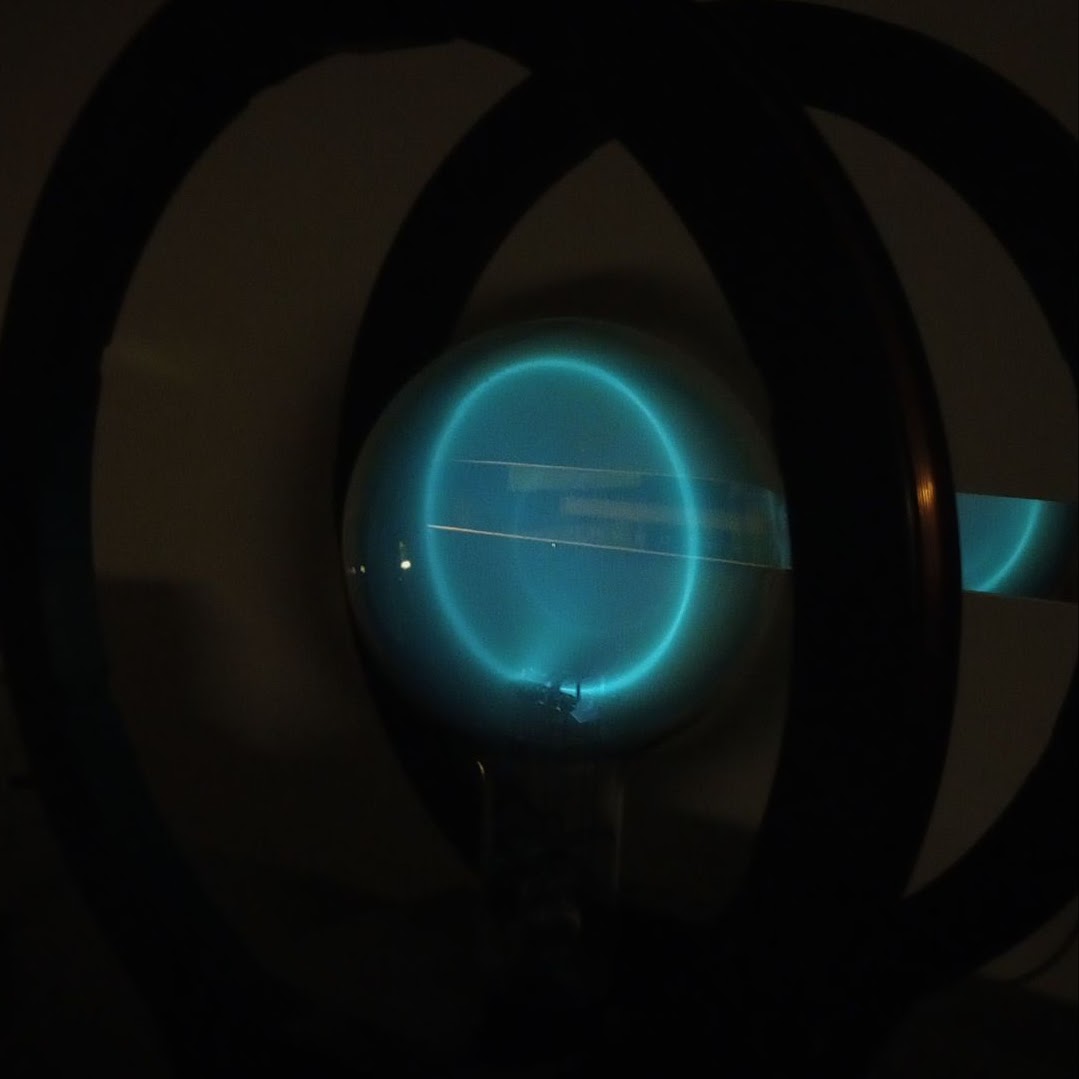
Measuring the radius of circular electron beams to determine the charge to mass ratio of the electron
Author: Justin Wheeler
Abstract: Electrons moving through a uniform magnetic field in the absence of an electric field experience a force resulting in circular motion. The radius of the circular motion due to the energy put into the electrons from the electron gun, and the strength of the applied magnetic field are related to the ratio of the charge of an electron to its mass. The squared radius of the curvature of the electron beam is found to be linearly related to the ratio of voltage and squared magnetic field strength by a constant term related to the charge to mass ratio of the electron. The measured electron charge to mass ratio is determined to be \((1.8 \pm 0.2) \times 10^{11} ~\text{C}/\text{kg}.\)
Measuring the electron mass-charge ratio with trajectories in a uniform magnetic field
Author: Kassia Schraufnagel
Abstract: The charge-mass ratio of the electron was one of the first measured characteristics of the electron. The original experiment that determined this ratio is replicated by measuring the radius of the electron trajectory in a uniform magnetic field. By relating this to the voltage of the electron gun and current of the coils producing the magnetic field, the mass-charge ratio is found to be \(4.8(1)\times 10^{-12 }\text{kg}/\text{C}\).
Validating the charge to mass ratio of an electron
Author: Kaitlyn Prokup
Abstract: During an experiment in 1897, J. J. Thomson discovered the existence of electrons, negatively charged subatomic particles found in the structure of atoms and responsible for various physical phenomena. Thomson also established a value for the mass to charge ratio of electrons by considering how the electromagnetic force deflects charged particles moving in a uniform magnetic field. Given the importance of electrons, this experiment seeks to confirm Thomson’s results. His process has been replicated using a vacuum tube apparatus consisting of a pair of Helmholtz coils to produce a magnetic field, a spherical evacuated tube containing helium to generate a trace of the electron path, and an electron gun in order to produce a beam of electrons. The accelerating electron voltage and the current of the Helmholtz coils were varied and the radius of the electron path was measured to derive a result of \(2.1(4) \times 10^{11} \text{C/kg}\) for the charge to mass ratio.