Historic electron measurements
Recreating physics history with Thomson's experiment measuring the charge-to mass ratio of the electron and Millikan's oil drop experiment.

Measuring the charge of an electron from the Millikan oil drop experiment
Author: Kassia Schraufnagel
Abstract: The charge of an electron is a fundamental constant important in many fields across physics. Using the Millikan oil drop experiment, the charges of oil drops are determined based on the velocity at which each drop falls. By analyzing the charge of the drops due to excess electrons, all of the charges are determined to be approximate multiples of each other and are all separated by the charge of an electron. Once the charge of each oil drop is determined, it is compared to the predicted amount of excess electrons, allowing the electron charge to be approximated: \(1.52(9) \times 10^{-19} \text{C}\).
Measuring the radius of circular electron beams to determine the charge to mass ratio of the electron
Author: Justin Wheeler
Abstract: Electrons moving through a uniform magnetic field in the absence of an electric field experience a force resulting in circular motion. The radius of the circular motion due to the energy put into the electrons from the electron gun, and the strength of the applied magnetic field are related to the ratio of the charge of an electron to its mass. The squared radius of the curvature of the electron beam is found to be linearly related to the ratio of voltage and squared magnetic field strength by a constant term related to the charge to mass ratio of the electron. The measured electron charge to mass ratio is determined to be \((1.8 \pm 0.2) \times 10^{11} ~\text{C}/\text{kg}.\)
Waves and Optics
Featuring a variety of experiments regarding microwave interferometry, waveguides, and standing sound waves.
Characterizing a Lloyd’s mirror interferometer
Author: Kaitlyn Prokup
Abstract: Lloyd's mirror interferometers are optical devices used in and relevant to many fields of research today, such as underwater acoustics, sonar research, and laser research. Our work sought to construct a Lloyd's mirror to justify the device's mechanisms and characterize it. We assembled our Lloyd's mirror by placing a transmitter at a distance d = 1.0287 m across from a receiver, with a metallic reflector placed perpendicular at a distance h to induce interference. To characterize our device, we derived a value for the wavelength of the signal emitted by the transmitter by varying h across a set of values 0.117 m to 0.320 m, where we subsequently measured the intensity I of the signal to be between 0.72 mA and 9.40 mA. This allowed us to analyze the interference to compute a value of λ = 0.031 ± 0.006 m for the wavelength.
Coaxial cable properties: determining the speed of signal and electric permittivity
Author: Carissa Kiehl
Abstract: The speed of signal in a coaxial cable can be determined by measuring the time delay between varying lengths of coaxial cables that are wired from a signal generator to an oscilloscope. The oscilloscope will show the time delay between the signals passing through each cable. Through many trials of varying cable length differences, a plot of length difference versus time delay can be generated. The slope of the regression line, adjusted to be in ft/ns, represents the speed of signal in the cable. This speed was determined to be 0.69 +- 0.04 ft/ns. The speed is used to calculate the cable's relative electric permittivity, which was determined to be 2.2 +- 0.2.
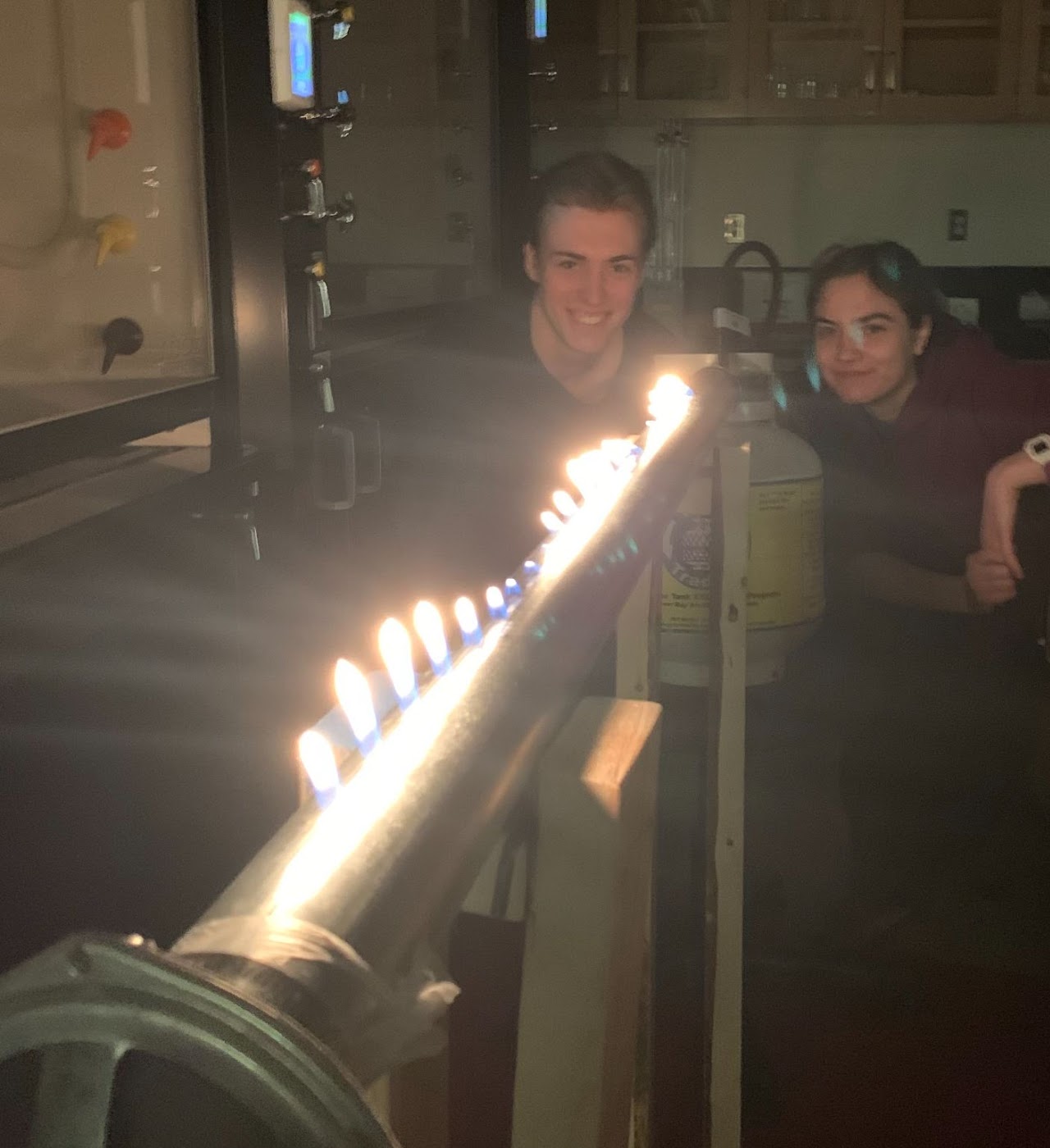
An Undergraduate’s Guide to the Rubens Tube; basic theory, construction, research, and outreach.
Author: Sophia Figura
Abstract: The Rubens tube is a popular demonstration to teach students and the public about waves. To operate, a speaker is used to form pressure waves within natural gas in a tube, producing flames with varying heights. A Rubens tube was constructed for use in outreach and to measure the speed of sound in the propane gas used. The speed of sound was measured to be 365 m/s, a 41% difference from the value quoted in the literature. The tube was successful at encouraging curiosity among physics students and the general population alike.
Aerospace Sciences
Two articles presenting original research in propellant gauging, and an overview of major topics in aerospace engineering.
Validating an ullage detection technique for liquid propellant tanks
Author: Justin Wheeler
Abstract: Knowledge of location of the ullage, the gas pocket within a liquid propellant tank, and ullage dynamics is of vital importance to deep-space refueling depots. Characterizing the size and location of the ullage within liquid propellant tanks in equilibrium is crucial to the Mars mission. An experiment payload was designed to test a method of gauging the size and location of the ullage within a liquid propellant tank. Broadband white noise is passed into a stainless steel tank filled with a rocket propellant simulant. The acoustic vibrations are measured at several point sensor locations along the surface where changes in amplitude are representative of changes in the thickness of the liquid layer coating the inside of the tank. The data suggests that the sensors are able to detect the passage of the liquid surface under the effect of gravity but are not accurate enough for space flight at the moment.
Astronomy and Astrophysics
Featuring three original articles on general relativity and current topics of interest in cosmology.
An Undergraduate Review of General Relativity and Cosmology
Author: Andrew Valentini
Abstract: General relativity is a subject that has too far-reaching of conclusions about the nature of reality and our universe to be only understood by specialists. If a non-specialist wishes to understand the theory without having to spend months or years studying it, they are often forced to resort to popular science articles that do not provide the theory's full depth and often simplify its details to the point of misrepresentation. In this report, I provide an introduction to general relativity at the undergraduate level that provides more insight into the theory than popular science treatments but does not utilize the level of rigor that is typically encountered in graduate-level treatments. I first give a justification for the hallmark of general relativity, the Einstein field equations, then show how they can be applied to describe a class of universes, and end by briefly reviewing the experimental results that confirm theoretical predictions made by these cosmological models. The intention of this report is not to properly educate a reader on general relativity and cosmology but to expose them to the basic theoretical structure of the matter and should serve as a starting point for the curious reader.
A crisis in cosmology? An overview of disagreements in the Hubble constant
Author: Riley H. Johnson
Abstract: Over recent years, a disagreement has emerged between the ways of measuring the Hubble constant. This constant describes the expansion rate of the universe and is critical in estimating its age. To determine the Hubble constant we use the relation between a measured distance, along with a velocity from a measured redshift of the light. This literature review seeks to provide a brief history of the constant, an overview of processes for measuring cosmological distances to calculate the Hubble constant, and present proposed solutions to the emerging "Hubble tension."