Aerospace Sciences
Two articles presenting original research in propellant gauging, and an overview of major topics in aerospace engineering.

Validating an ullage detection technique for liquid propellant tanks
Author: Justin Wheeler
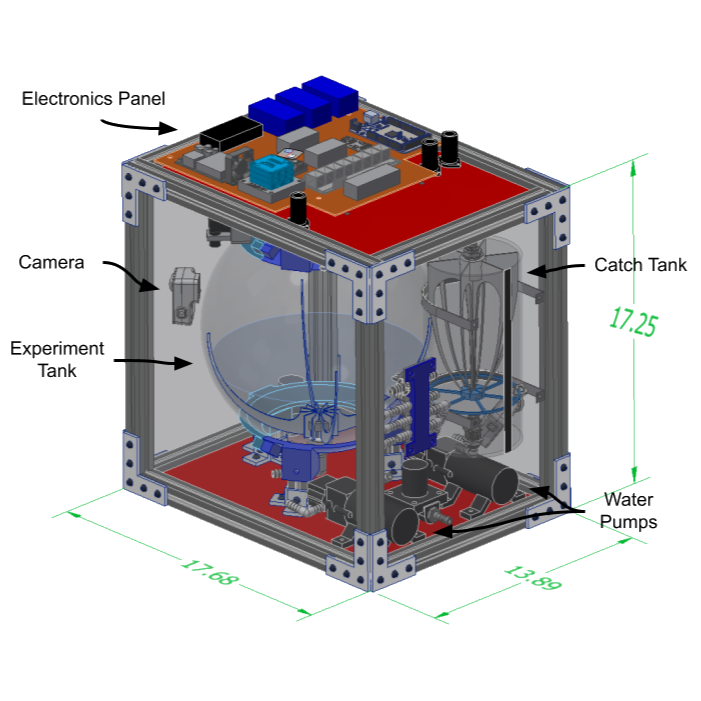
Abstract: Knowledge of location of the ullage, the gas pocket within a liquid propellant tank, and ullage dynamics is of vital importance to deep-space refueling depots. Characterizing the size and location of the ullage within liquid propellant tanks in equilibrium is crucial to the Mars mission. An experiment payload was designed to test a method of gauging the size and location of the ullage within a liquid propellant tank. Broadband white noise is passed into a stainless steel tank filled with a rocket propellant simulant. The acoustic vibrations are measured at several point sensor locations along the surface where changes in amplitude are representative of changes in the thickness of the liquid layer coating the inside of the tank. The data suggests that the sensors are able to detect the passage of the liquid surface under the effect of gravity but are not accurate enough for space flight at the moment.

Microgravity propellant gauging using modal analysis
Author: Kassia Schraufnagel
Abstract: Current microgravity propellant gauging technology is inaccurate and not universally applicable for use in future spacecraft. A new method of gauging propellant in microgravity environments that uses modal analysis is discussed. This method, Modal Propellant Gauging (MPG), measures the structural acoustic resonant frequencies of the tank to determine the added mass of the propellant. This is achieved by comparing the input white noise frequencies with the output resonant frequencies through a Frequency Response Function (FRF). From the FRF, the modal parameters of the tank can be determined and consequently, the amount of liquid in the tank. This method is discussed in the context of fluid transfer conditions to determine the success of MPG in a dynamic setting.
A literature review of aerospace engineering
Author: Clayton Markech
Abstract: This paper examines the aerospace engineering field and sub-fields within aerospace engineering. We explore five sub-fields related to the subject. Aeroacoustics, investigating the generation and control of noise in aerodynamic systems; Aeroelasticity, exploring the interactions between structural dynamics and aerodynamics; Combustion and Propulsion, driving the advancement of air and spacecraft propulsion systems; Systems design, integrating the components into a reliable and efficient system; and Uncrewed Aerial Vehicles (UAVs), revolutionizing the aerospace field with autonomous and remotely piloted vehicles. By examining the sub-fields, we aim to comprehensively understand of the history, current state, and future of aerospace engineering.